
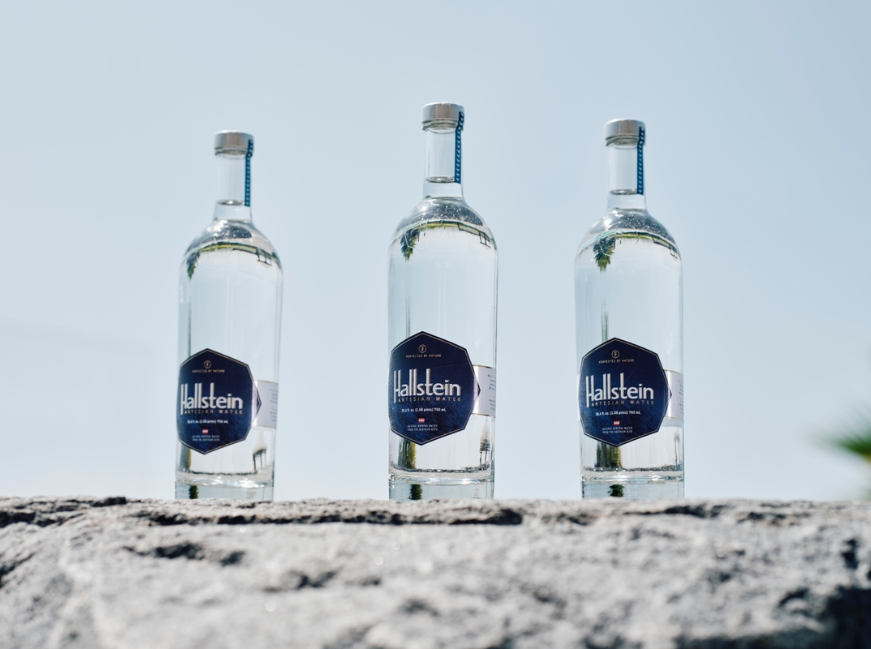
Water at Its Purest: Why Hallstein Is Worth Every Sip This Festive Season
We’ve chosen Hallstein as our must-have water for the festive season. It’s not for everyone, but for those who care about wellness, purity, and performance, it’s worth understanding why this deep-source, untouched water commands a premium. So we took a closer look at what sets it apart from the usual bottled choices on the shelf, and why so many water experts consider deep-source, untreated water a ‘must-have’ rather than a luxury.
Take Martin Riese, one of the world’s leading water sommeliers. He describes water as a “natural product with terroir,” shaped entirely by its environment. He tastes it the way you would a fine wine (we love this!!); swirling, assessing texture, minerality, balance.
Because to him, the source is everything: “Where the water is coming from matters more than the brand.” He also points out that most bottled water on the market is simply processed, filtered water, while only a small percentage comes from genuinely protected, naturally occurring aquifers.
That’s where Hallstein stands out. It’s drawn from a deep Alpine aquifer, bottled at the source, and left completely untouched. No filtration, no chemical treatment, no mineral tampering. You’re drinking it exactly as the earth produced it. It’s also the only water that meets all eight scientifically proven criteria for optimal drinking water naturally, without any processing. For people conscious of microplastics, PFAS, or packaging-related contaminants, that difference is meaningful.
Here’s how Hallstein compares with typical bottled water, based on publicly available testing, sourcing information and packaging standards:
| Feature / Risk | Typical Bottled Water | Hallstein Water |
| Source protection | Often spring or surface sources; may be exposed to surface runoff, farming pollution or microplastics | Deep, protected Alpine aquifer (approx. 214m), naturally shielded from contaminants |
| Processing & treatment | Frequently filtered, treated or stored before bottling; processing can introduce contaminants | Zero treatment: bottled at source with no filtering, no chemical processes, no alteration |
| Microplastics / nanoplastics risk | Many studies report presence of microplastics and potential plastic-derived chemicals in plastic-bottled water | Independently tested for 100+ contaminants; published results show no detectable microplastics, PFAS or VOCs |
| Mineral balance & pH | Mineral levels vary widely; some are stripped then artificially added back | Naturally alkaline (~8.3 pH), balanced Ca:Mg ratio, low sodium – ideal for hydration and nutrient absorption |
| Packaging-related contamination | Plastic bottles may leach compounds, especially with heat or sunlight exposure | Bottled in recycled glass or inert, BPA-free Tritan to minimise plastic-related contamination |
For many people, paying a premium for water seems indulgent… until you consider how much water you drink every single day, and how few products you consume as consistently. Water sommeliers argue that the purity and balance of your water can influence digestion, hydration efficiency and overall wellness. Or, as Riese puts it, “Water can create wellness.”
So, while Hallstein may not be everyone’s everyday choice, it’s an undeniably elevated one that is clean, balanced, unprocessed hydration designed for people who want the very best entering their body.
As for the festive season, it’s a statement: rare, thoughtful, and scientifically grounded in purity. If there were ever a time to try it, this is it.